
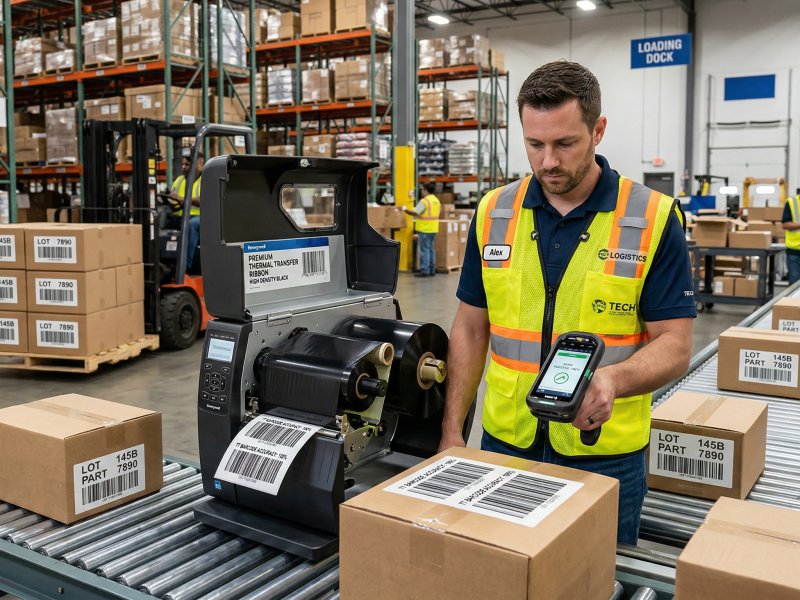
Barcode accuracy is essential for modern logistics, manufacturing, and retail operations. From tracking inventory inside warehouses to managing shipments across global supply chains, businesses rely on barcode scanning systems to capture data quickly and accurately.
However, when barcode scans fail or become inconsistent, the issue is often traced back to the label printing process itself. Poor print quality, faded barcodes, or damaged labels can cause scanners to misread codes, slowing down workflows and increasing operational errors.
One of the most effective ways to maintain reliable barcode printing is by using high-quality thermal transfer ribbons. When paired with compatible label materials and printers, thermal ribbons help produce clear, durable barcodes that remain readable throughout the product lifecycle.
Solutions such as label printer ribbon are widely used across industries that require durable barcode printing for inventory tracking, asset labeling, and shipping operations.
Why Barcode Print Quality Matters
Barcode scanners rely on contrast between black bars and the label background to read information accurately. When printing quality drops—whether due to worn ribbons or low-quality materials—the barcode pattern may become distorted.
This can lead to several operational problems:
- Multiple scanning attempts during picking and packing
- Manual barcode entry when scanning fails
- Slower warehouse workflows
- Inventory tracking inaccuracies
Maintaining strong print contrast and durability is therefore essential for reliable barcode performance.
Understanding Thermal Transfer Printing
Thermal transfer printing is one of the most widely used technologies for producing durable barcode labels. Unlike direct thermal printing, which prints directly on heat-sensitive paper, thermal transfer printing uses a ribbon to transfer ink onto the label surface.
During printing, heat from the print head melts the ink on the ribbon, transferring it onto the label material to form text, graphics, and barcodes.
This method offers several advantages:
- More durable barcode printing
- Better resistance to heat and abrasion
- Suitable for long-term labeling applications
- Compatibility with various synthetic label materials
As explained by Zebra Technologies, thermal transfer printing is commonly used in industries that require labels to remain readable for extended periods.
Using a reliable label printer ribbon helps ensure consistent barcode print quality, allowing scanners to capture information quickly and accurately during warehouse and logistics operations.
How Thermal Transfer Ribbons Improve Barcode Accuracy
Thermal transfer ribbons play a critical role in determining how well barcodes are printed and how long they remain readable.
The quality of the ribbon affects several key aspects of barcode printing:
| Printing Aspect | Low-Quality Thermal Ribbon | High-Quality Thermal Ribbon |
| Barcode sharpness | Faded or uneven barcode lines | Crisp, well-defined barcode edges |
| Scan reliability | Frequent scanning errors | Consistent and accurate scanning |
| Resistance to friction | Ink scratches easily | Resistant to abrasion and handling |
| Print durability | Barcode fades over time | Long-lasting barcode visibility |
Using reliable ribbons ensures that barcode lines remain clearly defined, allowing scanners to capture information quickly and accurately.
Using a reliable thermal transfer ribbon helps ensure consistent barcode print quality, allowing scanners to capture information quickly and accurately during warehouse and logistics operations.
Common Causes of Poor Barcode Printing
Even when using good printers and label materials, barcode quality can still suffer if the ribbon is not suitable for the application.
Some common issues include:
Low Ribbon Quality
Cheap ribbons may produce uneven ink transfer, resulting in faded or incomplete barcodes.
Incorrect Ribbon Type
Different applications require different ribbon types, such as wax, wax-resin, or resin ribbons. Using the wrong ribbon may reduce print durability.
Environmental Exposure
Labels exposed to friction, heat, or chemicals may degrade if the printed ink layer is not strong enough.
High-Volume Printing
In warehouses with high printing volumes, ribbon consistency becomes critical to maintain uniform barcode quality across thousands of labels.
Choosing reliable thermal ribbons helps minimize these issues.
Types of Thermal Transfer Ribbons
Thermal transfer ribbons are available in several types, each designed for specific labeling applications.
| Ribbon Type | Key Characteristics | Common Applications |
| Wax Ribbon | Cost-effective, suitable for paper labels | Shipping labels, retail labeling |
| Wax-Resin Ribbon | Improved durability and scratch resistance | Logistics, warehouse labeling |
| Resin Ribbon | Highest durability, resistant to chemicals and heat | Manufacturing, electronics labeling |
Selecting the right ribbon type helps ensure that printed barcodes remain readable throughout the product lifecycle.
A high-quality label printer ribbon supports reliable barcode printing across a wide range of industrial labeling applications.
Industries That Benefit from Thermal Transfer Ribbons
Thermal transfer ribbons are widely used in industries that rely on durable barcode labeling for operational efficiency.
Logistics and Warehousing
Shipping labels must remain readable during transportation and handling. Durable ribbon printing helps prevent barcode fading.
Manufacturing
Products and components often require long-term identification labels that can withstand industrial environments.
Retail and Distribution
Retailers rely on barcode labels for inventory tracking and point-of-sale scanning.
Electronics and Asset Tracking
High-durability labels are needed for equipment identification and asset management.
Reliable ribbons ensure barcode consistency across these different environments.
Best Practices for Maintaining Barcode Print Quality
To maintain reliable barcode printing performance, businesses should consider several best practices.
| Best Practice | Operational Benefit |
| Use high-quality ribbons | Improved print clarity |
| Select the correct ribbon type | Better durability |
| Maintain printer settings | Consistent barcode size |
| Store ribbons properly | Prevent ribbon damage |
These practices help maintain consistent barcode readability and reduce scanning issues in operational environments.
Reliable Thermal Transfer Ribbons for Barcode Printing
Barcode systems depend on clear and durable printed labels to function efficiently. When barcode print quality drops, operations may experience scanning errors, slower workflows, and increased manual work.
Using reliable thermal transfer ribbons helps maintain consistent barcode clarity across different labeling applications.
Businesses looking for dependable barcode printing supplies can explore label printer ribbon available at allid.com.ph . These ribbons are designed to support high-quality barcode printing for logistics, manufacturing, and inventory management environments.
Visit allid.com.ph to learn more about thermal ribbon solutions that help improve barcode accuracy and labeling performance.
