
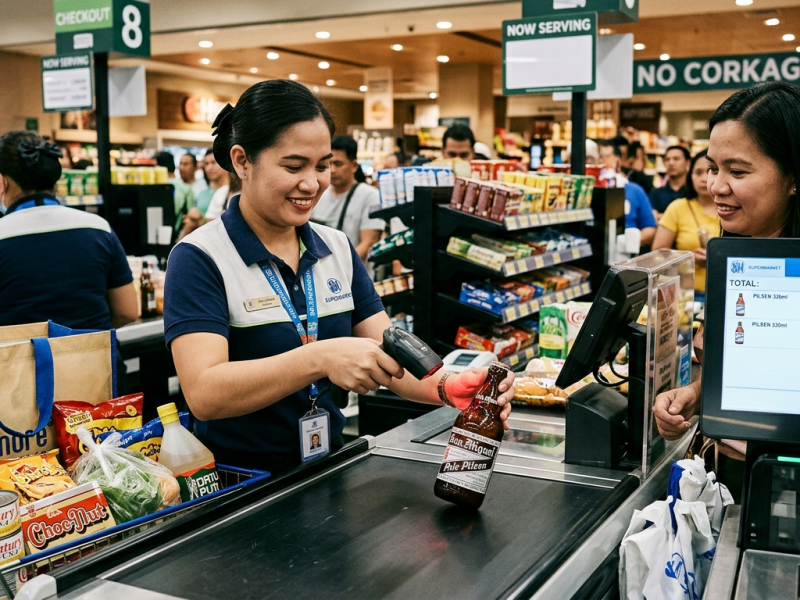
Walk into any SM Supermarket, Robinsons, or Puregold on a busy Saturday afternoon and you will see it firsthand: long queues, impatient shoppers, and cashiers under pressure to keep the lines moving. In a country with over 2,000 supermarket branches nationwide and a retail sector growing at a steady pace, slow checkout is not just a customer experience problem; it is a revenue problem. The good news? The right barcode scanner can cut checkout time dramatically, reduce human error, and keep both customers and store managers happy.
In this article, we break down how Philippine supermarkets are using barcode scanning technology at the point of sale, what to look for in a POS scanner, and which products are best suited for the high-volume demands of retail.
Why Checkout Speed Matters in Philippine Supermarkets
Philippine supermarkets handle some of the highest foot traffic in Southeast Asia, especially in Metro Manila, Cebu, and Davao. During peak hours, weekends, paydays, and holidays, a single cashier may need to process hundreds of items per hour. A slow or unreliable scanner means longer queues, frustrated customers, and lost sales.
Here is where modern 2D barcode scanners make a real difference. Unlike older 1D laser scanners that struggle with damaged, wrinkled, or low-contrast barcodes, today’s imaging scanners read barcodes instantly from almost any angle, no need to align the label perfectly. For a cashier processing 300+ items per shift, that improvement in first-scan read rates adds up to hours of saved time every week.
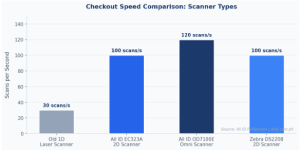
Figure 1: Scan speed comparison across scanner types. A modern 2D scanner can process up to 4× more scans per second than a legacy 1D laser device.
Common Ways Barcode Scanners Are Used in Supermarkets
- Point-of-Sale (POS) Checkout
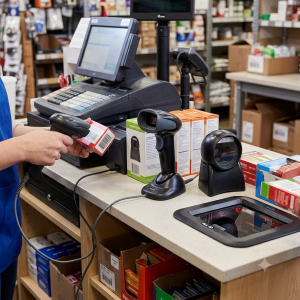
The most visible use case is at the checkout counter. A corded POS scanner sits next to the register and reads product barcodes as the cashier passes items across. Modern scanners like the Zebra DS2208 2D Barcode Scanner are designed specifically for this environment: fast, accurate, and easy to use with zero training required. The DS2208 features Zebra’s PRZM Intelligent Imaging technology, which delivers consistent scanning even on printed coupons, loyalty cards, and mobile phone screens.
- Price Verification Kiosks
Many supermarkets place barcode scanners at price-check kiosks throughout the store. Shoppers can scan items themselves to confirm prices before heading to checkout. The All ID OD7100E 2D Omni Directional Barcode Scanner is ideal here, it captures barcodes from virtually any angle and works with both 1D and 2D codes, including QR codes.
- Receiving and Stockroom Operations
Before products ever reach the shelf, they pass through a receiving area where staff verify delivery quantities against purchase orders. The All ID EC323A 2D Corded Barcode Scanner is built for exactly this kind of high-volume scanning, it handles over 100 scans per second, has a rugged housing that survives drops and spills, and provides clear audio and visual feedback on every successful scan.
- Loyalty Card and Coupon Scanning
Modern retail promotions increasingly rely on digital coupons and loyalty barcodes on mobile phones. Scanning a barcode from a smartphone screen requires a scanner with strong imaging capability, one that handles backlit, glare-prone screens without multiple attempts. The Zebra DS2208 handles this natively, making it a popular choice for supermarkets running mobile loyalty programs.
The Business Case: Performance Impact of Upgrading to a 2D Scanner
Upgrading from an old 1D laser scanner to a modern 2D imaging scanner isn’t just about speed, it improves outcomes across your entire store operation. The chart below illustrates the typical performance difference across four key metrics:
Figure 2: Operational performance comparison, stores using 2D barcode scanners consistently outperform those still relying on legacy 1D devices across checkout speed, scan accuracy, stockroom efficiency, and promotion success rates. (Illustrative estimates based on industry benchmarks.)
Product Feature Comparison: Which Scanner Is Right for You?
Here is a side-by-side feature breakdown of the top scanners available from All ID Philippines for supermarket and retail use:
| Feature | Zebra DS2208 | All ID EC323A | All ID OD7100E |
|---|---|---|---|
| Scans 1D Barcodes | ✓ | ✓ | ✓ |
| Scans 2D / QR Codes | ✓ | ✓ | ✓ |
| Scans from Phone Screen | ✓ | ✓ | ✓ |
| Omni-directional Scanning | ✗ | ✗ | ✓ |
| Scans per Second | ~100 | ~100 | ~120 |
| Drop Resistance | 1.5 m | 1.5 m | 1.5 m |
| Plug-and-Play USB Setup | ✓ | ✓ | ✓ |
| Best Use Case | POS / Loyalty | POS / Stockroom | Kiosk / Hands-free |
| Ideal Store Size | All sizes | All sizes | Mid to Large |
Choosing the Right Scanner by Store Size
Not sure which scanner fits your setup? Use this quick reference:
| Store Type | Scan Volume | Recommended Scanner | Why |
|---|---|---|---|
| Sari-sari / Convenience Store | Low–Medium | All ID EC323A | Affordable, fast, plug-and-play |
| Mid-size Supermarket (5–15 lanes) | Medium–High | Zebra DS2208 + OD7100E | DS2208 for POS; OD7100E for kiosks |
| Hypermarket / Department Store | Very High | Full AIDC Solution | Mix of scanners + mobile computers |
| Self-Checkout Lanes | High | All ID OD7100E | Hands-free omni-directional scanning |
What to Look for in a Supermarket Barcode Scanner
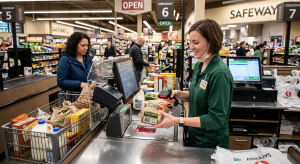
Not all barcode scanners are created equal. Here are the key features to prioritize:
- 1D and 2D scanning capability, Supermarkets deal with product UPCs (1D), QR promotions, loyalty apps, and GS1 DataMatrix codes. A 2D scanner handles all of these.
- Omni-directional scanning, Cashiers should not need to reposition items to get a scan.
- High scan rate, In a busy checkout lane, you want a scanner that can process 100+ scans per second.
- Durability, Scanners in supermarkets take daily abuse: knocked off counters, exposed to moisture, used for 12+ hour shifts. Pick a drop-tested, splash-resistant model.
- Ease of setup, Plug-and-play USB means your IT team doesn’t spend hours configuring devices.
Frequently Asked Questions
What is the difference between a 1D and 2D barcode scanner?
A 1D scanner reads linear barcodes (like standard UPC stripes). A 2D scanner reads both linear barcodes and 2D codes such as QR codes, Data Matrix, and PDF417, formats common in digital coupons, loyalty apps, and pharmaceutical labels. For most Philippine supermarkets, a 2D scanner is the better long-term investment.
Do I need a corded or wireless scanner for checkout?
For fixed checkout counters, a corded scanner is the most practical, no battery management, no connectivity issues. For staff who move around the floor, a wireless scanner offers better flexibility.
How long do barcode scanners last in a supermarket environment?
Well-built scanners like the Zebra DS2208 and All ID EC323A are designed for multi-year use in commercial environments. They are drop-tested and built for daily retail rigors. Most units from All ID Philippines come with a manufacturer’s warranty and local technical support.
For Philippine supermarkets looking to reduce checkout queues, eliminate scan errors, and keep customers moving, investing in the right barcode scanner is one of the highest-ROI technology decisions you can make. Whether you run a single sari-sari store or manage a chain of supermarkets across the country, All ID Philippines has a scanner that fits your needs and budget.
From the reliable Zebra DS2208 to the high-speed All ID EC323A and the versatile All ID OD7100E omni-directional scanner, the right solution is just a click away.
